Introduction
The merger of a binary system (e.g. two black holes) generates gravitational waves. A typical amplitude from detected signals is divided into three main phases, as shown in Figure 1. This course will focus primarily on the first inspiral phase, where the two black holes are still well separated.
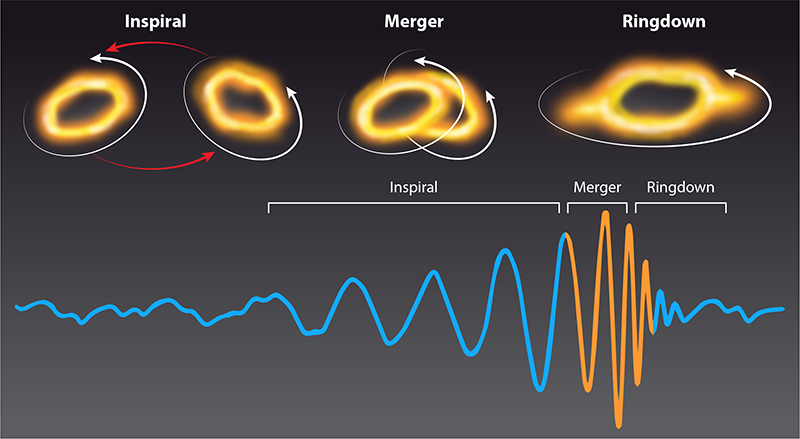
Figure 1:A typical gravitational-wave signal produced by a pair of coalescing black holes. The inspiral phase can be described by post-Newtonian series expansion, while the late part of the ringdown phase can be described using linear perturbation theory (blue parts of the signal). The merger and early ringdown, however, exhibit nonlinear spacetime dynamics (orange part of the signal).
How does one extract the properties of the binary black holes (e.g. the masses of the two BHs, their distance from us, etc.) from the data?
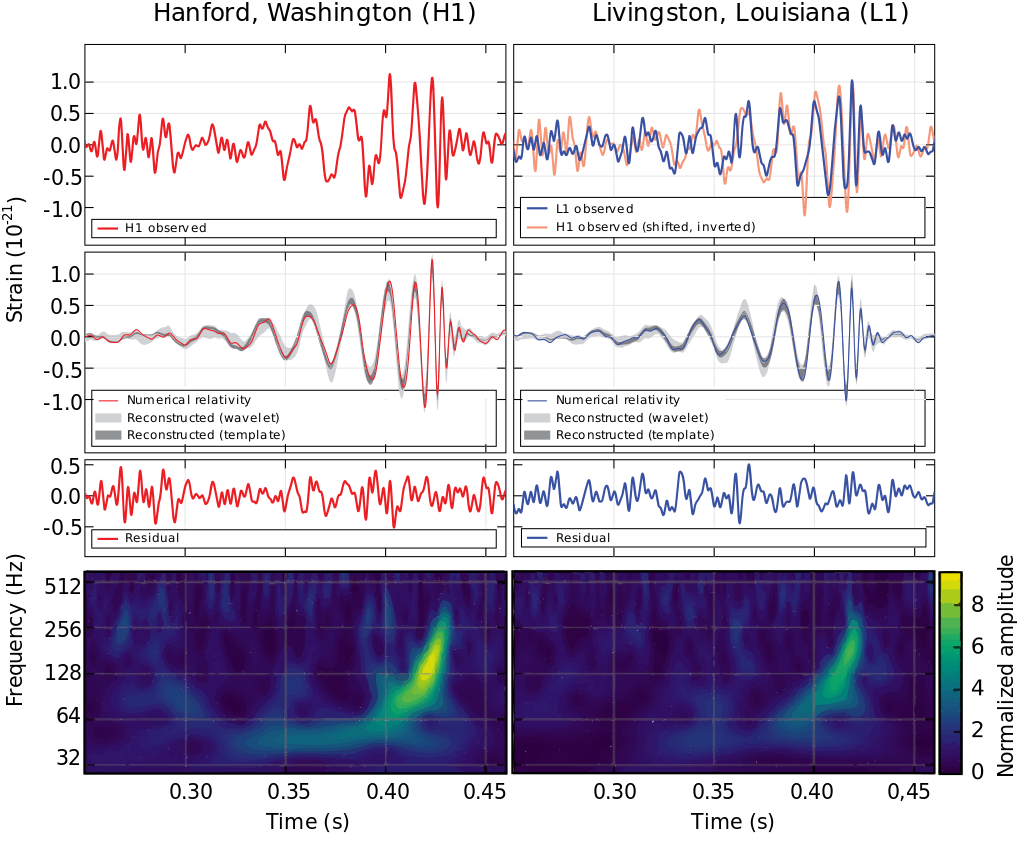
Figure 2:LIGO measurement of gravitational waves at the Livingston (right) and Hanford (left) detectors, compared with theoretical predicted values.
To study the inspiral phase, we can use perturbation theory:
where can be the Minkowski or FLRW metric, depending on whether we are studying binary systems on astrophysical or cosmological scales.
Gravitational waves in cosmology
Gravitational waves play an increasingly important role in cosmology, with two main applications:
measurement: by observing individual sources (e.g. binary black holes) on cosmological scales, we can independently measure the Hubble constant.
Stochastic Gravitational Wave Background (SGWB): analogous to the CMB for photons, this background carries information about the early universe. At high redshifts (), there are two main components:
Astrophysical components: individual signals from many unresolved sources superpose to form a background.
Cosmological/primordial components: originating from primordial sources in the early universe (e.g. inflation, phase transitions, cosmic strings).
Strong evidence for SGWB
In Summer 2025, pulsar timing array collaborations announced strong evidence for a stochastic gravitational wave background.
Observation time: yr
Characteristic frequency: Hz
Corresponding wavelength:
This opens a new window to test Grand Unified Theories (GUTs) and early universe physics.
Order of magnitude estimates for black hole ringdown
During the ringdown phase, a perturbed black hole oscillates at characteristic complex frequencies (quasinormal modes):
Oscillation frequency: for the fundamental mode ():
More generally, .
Decay time scale:
where is the overtone number. For the fundamental mode, .
A summary of the key gravitational-wave observables for different detectors:
| Detector | (typical) | (ringdown decay time) | Typical |
|---|---|---|---|
| LVK (LIGO/Virgo/KAGRA) | –103 Hz | –10-2 s | – |
| LISA | –10-1 Hz | –104 s | – |
| PTA (Pulsar Timing Arrays) | –10-7 Hz | –109 s | – |
First detection of a black hole ringdown
By LVK (from GW150914)
Provided the first direct observation of the quasinormal modes predicted by general relativity.
Measuring the amplitudes and frequencies of these modes opens the possibility to test the Hawking area theorem: that the total horizon area after merger should satisfy .
While current LVK data are consistent with this bound, higher signal-to-noise detections of multiple ringdown modes in the future could provide a quantitative test of this fundamental prediction.
Detector types
Laser interferometers
LVK (LIGO, Virgo, KAGRA) and LISA are interferometers based on Michelson–Morley experiments.
The basic principle: measure tiny changes in arm length caused by passing gravitational waves (GW).
LVK network: 2 detectors in the USA (LIGO Hanford & Livingston), 1 in Pisa (Virgo), 1 in Japan (KAGRA).
Fixed on Earth → limited angular resolution; multiple detectors needed to triangulate the sky position:
If , then (smaller than a proton!)
LISA: , space-based for low-frequency GW detection.
Pulsar Timing Arrays (PTA)
Use extremely regular pulsar signals ().
Monitor many pulsars over years ( decades) sensitive to very low-frequency GWs, .
Statistics from an ensemble of pulsars allow detection of stochastic GW background.
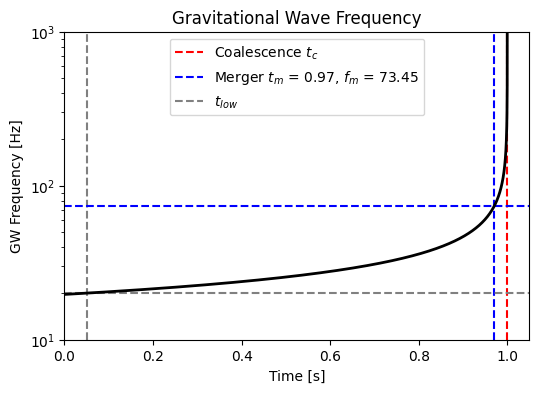
Inspiral phase of a binary system
Valid when two objects are far apart. Linear perturbation theory applies:
Features of the inspiral:
Time to merge (assuming ):
Amplitude and distance:
Maximum GW amplitude occurs at where .
Typical GW properties for different binaries
| Source type | Binary NS | Stellar-mass BH | Supermassive BH |
|---|---|---|---|
| Mass | |||
| Mass | |||
| Time to merger | years | ||
| Typical distance | Gpc | ||
| Amplitude at merge | |||
| Typical strain radius | 10– | AU–pc scale |